

7-Day Japan Travel Itinerary: The Ultimate First-Time Visitor’s Guide
Japan has a way of doing something no other destination quite manages it overwhelms you and calms you at the exact same time. One moment you’re standing in Shibuya Crossing surrounded by thousands of people, and the next you’re sitting in a quiet bamboo grove in Kyoto listening to nothing but wind. That contrast the ancient and the ultramodern is what makes Japan unlike anywhere else on earth.
A 7-day Japan itinerary is the sweet spot for first-timers. Long enough to see the country’s iconic highlights. Short enough to stay sane. And structured enough that you’re not wasting precious days figuring out which train to catch.


Before You Go: Japan Travel Essentials
A 7-day Japan itinerary for first-time visitors typically covers Tokyo (days 1–3), a day trip to Hakone (day 4), Kyoto (days 5–6), and Osaka (day 7). This route balances modern cities, ancient temples, iconic food experiences, and scenic landscapes giving you a well-rounded introduction to Japan in one week.
Also Read On:
Get these right before you land and the whole trip runs smoother.
Japan Rail Pass (JR Pass): This must be purchased before arriving in Japan through an overseas retailer. For this itinerary covering Tokyo, Kyoto, and Osaka, it pays for itself within the first few train journeys. The Tokyo–Kyoto shinkansen alone costs around ¥14,000 one way.
Suica or Pasmo Card: Pick up one of these rechargeable IC cards at the airport. They work on metro lines, local buses, and even convenience stores. Load ¥5,000–¥10,000 and top up as needed.
Cash: Japan remains largely cash-dependent. Withdraw yen at 7-Eleven ATMs — one of the most reliable options for international cards and always keep ¥5,000–¥10,000 on hand.
Pocket Wi-Fi or SIM: Google Maps is your lifeline here. Rent a pocket Wi-Fi device at the airport or pick up a data SIM on arrival.
Cultural Basics: Remove shoes when entering traditional establishments, avoid talking on phones in trains, carry a small bag for your rubbish (public bins are rare), and learn three words sumimasen (excuse me), arigato (thank you), and hai (yes). That alone gets you surprisingly far.
7-Day Itinerary at a Glance
| Day | Location | Highlights |
|---|---|---|
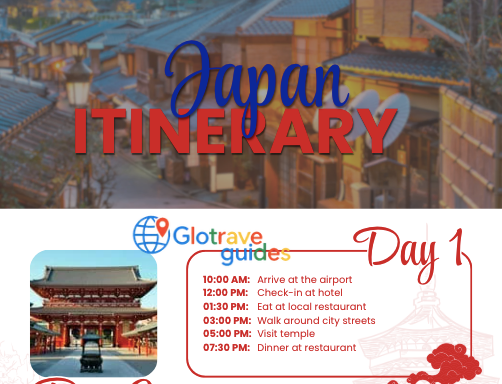
| Day 1 | Tokyo | Arrival, Shinjuku, Omoide Yokocho |
| Day 2 | Tokyo | Shibuya, Harajuku, Meiji Shrine, Akihabara |
| Day 3 | Tokyo | Asakusa, Senso-ji, Ueno, teamLab |
| Day 4 | Hakone | Mt. Fuji views, onsen, ryokan |
| Day 5 | Kyoto | Fushimi Inari, Nishiki Market, Gion |
| Day 6 | Kyoto | Arashiyama, Kinkaku-ji, Philosopher’s Path |
| Day 7 | Osaka | Osaka Castle, Dotonbori, street food, departure |
Days 1–3: Tokyo
Day 1 is for settling in. Land, check into your hotel in Shinjuku, and resist the urge to overdo it. Wander through Omoide Yokocho a narrow alley of tiny yakitori stalls that haven’t changed since the 1950s grab a cold beer and a plate of grilled skewers, and let the city find you rather than chasing it.
Day 2 is full Tokyo. Start at Shibuya Crossing early the morning rush has an energy that photographs simply can’t capture. Walk to Harajuku for Takeshita Street’s wild fashion scene, then cross into the forested calm of Meiji Jingu Shrine, one of the most peaceful hours you’ll spend in a city of 14 million people. Wrap up the evening in Akihabara, where multi-floor electronics shops, retro arcades, and neon-lit streets create a spectacle entirely their own.
Day 3 is for old Tokyo and unforgettable art. Arrive at Senso-ji Temple in Asakusa before 8am — the crowds arrive fast and the morning atmosphere, incense curling through quiet air, disappears with them. Spend the afternoon at Ueno, home to the Tokyo National Museum and one of Japan’s best parks. Book your evening at teamLab well in advance; these immersive digital art installations sell out weeks ahead and are worth every yen of the ¥3,200 ticket.
Day 4: Hakone — Mt. Fuji and Hot Springs
Take the Romancecar train from Shinjuku (90 minutes) and step into a completely different Japan. Hakone is a mountainous hot spring resort town that offers the most accessible views of Mt. Fuji available without hiking the mountain itself.
Spend the morning at the Hakone Open Air Museum, then board the ropeway over volcanic peaks before taking the lake cruise on Lake Ashi. When the sky is clear, the reflection of Mt. Fuji in the lake is a sight that earns its reputation completely.
If your budget allows, one night in a ryokan here is among the most memorable things you can do in Japan — sleeping on a futon, soaking in an outdoor onsen, eating a multi-course kaiseki dinner. Prices start from around ¥15,000 per person including meals. Even if you return to Tokyo that evening, a few hours in Hakone justifies the trip entirely.
Days 5–6: Kyoto
The shinkansen from Tokyo takes just over two hours and deposits you in Japan’s cultural heartland. Kyoto held the imperial capital for over a thousand years, and it shows in every temple gate, every cobbled laneway, every perfectly raked stone garden.
Day 5 begins at Fushimi Inari Taisha arrive before 7am. The thousands of vermilion torii gates winding up the mountain are among the most photographed images in Japan, and the upper trails stay quiet and atmospheric long after the lower sections fill with visitors. Afternoon belongs to Nishiki Market, a five-block covered market known as Kyoto’s Kitchen, packed with pickled vegetables, fresh tofu, and street food worth stopping for. As evening falls, walk through Gion, Kyoto’s famous geisha district, where lantern-lit wooden teahouses line the streets and the atmosphere feels genuinely unchanged from centuries past.
Day 6 starts in Arashiyama. The bamboo grove is magical but only before the crowds arrive. Get there by 7am. Visit Tenryu-ji Temple next door, then make your way to Kinkaku-ji, the Golden Pavilion, where gold-leaf-covered walls reflect in the mirror pond below and somehow still manage to exceed expectations. Spend the afternoon on the Philosopher’s Path, a two-kilometer canal-side walk connecting temples through a canopy of cherry trees and neighbourhood coffee shops. It’s the finest afternoon walk in Kyoto.
Day 7: Osaka — Eat Everything
The train from Kyoto takes 15 minutes. The shift in atmosphere takes about 30 seconds. Osaka is warmer, louder, and more proudly food-obsessed than anywhere else in Japan. There’s a local phrase kuidaore, meaning “eat until you drop” that tells you everything you need to know about how to approach this city.
Start at Osaka Castle for context and city views, then head to Kuromon Ichiba Market for a mid-morning tasting session of grilled seafood and fresh produce. The afternoon belongs entirely to Dotonbori takoyaki (octopus balls), okonomiyaki (savoury pancakes), kushikatsu (deep-fried skewers), ramen, and the best people-watching in Japan. The giant Glico Running Man sign photo is mandatory. No apologies.
Kansai International Airport connects easily to the city by the JR Haruka Express, giving you time for one final riverside walk before heading home.
Quick Budget Guide
| Category | Budget | Mid-Range |
|---|---|---|
| Accommodation (per night) | ¥4,000–¥8,000 | ¥10,000–¥20,000 |
| Daily food | ¥2,000–¥3,500 | ¥4,000–¥7,000 |
| Local transport | ¥500–¥1,000/day | ¥1,000–¥2,000/day |
| JR Pass (7-day) | ¥50,000 | ¥50,000 |
Top Mistakes to Avoid
- Not buying your JR Pass before arrival — it cannot be purchased inside Japan
- Skipping teamLab booking — tickets sell out weeks in advance
- Over-scheduling — rushing five cities in seven days exhausts you before it impresses you
- Ignoring convenience stores — 7-Eleven and Lawson food in Japan is genuinely excellent and cheap
- Forgetting cash — many temples, local restaurants, and small shops are cash only
Final Thoughts
Seven days in Japan will do something to you. You’ll leave having eaten some of the best food of your life, stood inside ancient temples, ridden the fastest trains in the world, and walked neighborhoods that feel like they’ve barely changed in centuries all in the same week.
Buy your JR Pass early, book teamLab the moment your dates are confirmed, and go in with enough flexibility to let Japan surprise you. It will.
Ready to go deeper? Browse our full Japan destination guides, download the free travel checklist, and start planning your first trip to Japan today.